Why Microsoft 365, US Flights and Chase All Broke in One Week
In five days in November 2026, Microsoft 365 email failed, US flights were stopped and Chase payments slowed. No sign of a cyberattack has been made public. Here is what is known about each one.
 Watch the short videoProfessor Chalk on YouTube
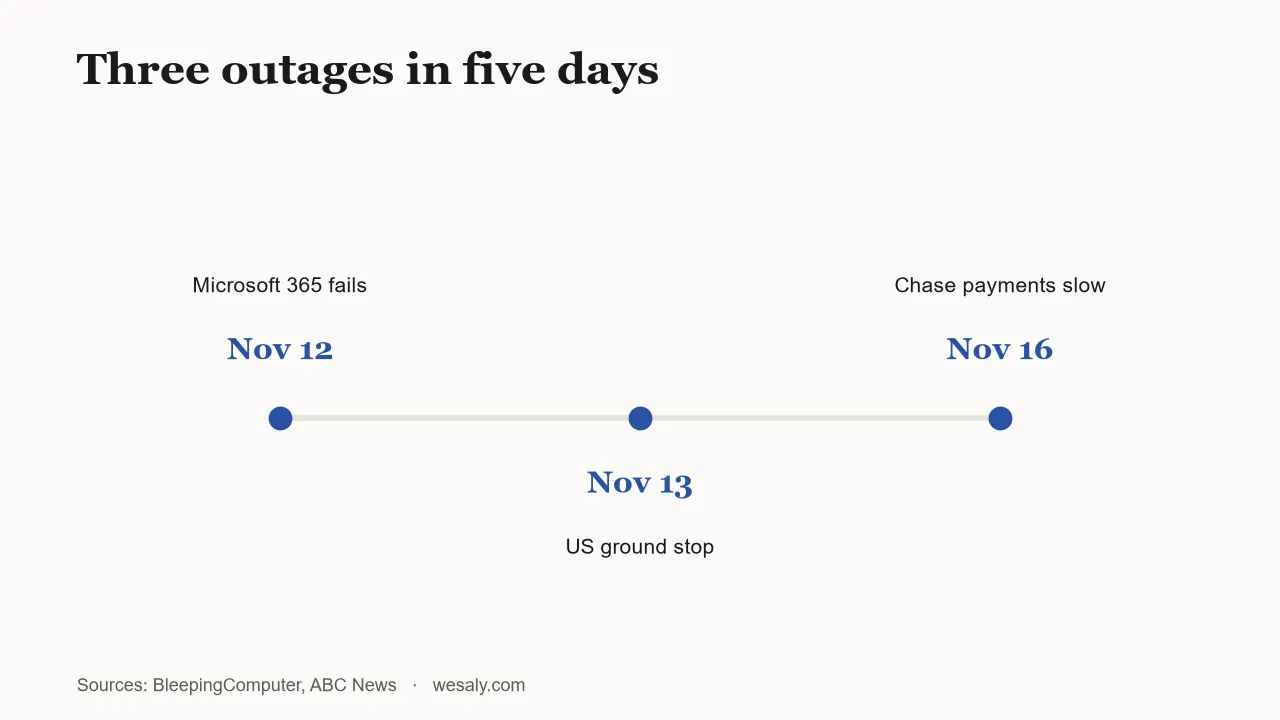
Between November 12 and November 16, 2026, three systems that millions of people rely on went wrong. Microsoft 365 email stopped working for most users. The United States held flights on the ground across the country. Then payments slowed at Chase, one of the country's biggest banks.
It looked like one attack. Nothing made public so far says it was. Each organization pointed to its own fault, and the explanations are oddly similar: something small failed, and a busy system made it worse.
Outage one: Microsoft 365
Microsoft's preliminary report gives the times as 4:20 p.m. UTC on Thursday, November 12 to 4:10 p.m. UTC on Friday, November 13, almost 24 hours. Email was hit hardest: most users could not open their mailbox. Teams chats and meetings mostly kept working.
The report lists three causes that met at the same time:
- A hidden bug. A fix for the gateway servers that began rolling out in July carried a defect. It ran worldwide for more than three months without trouble, because it only showed up under certain kinds of load.
- Extra traffic. About 15 hours before the outage, Teams switched over to the same gateway that carries email. Switches like that are normal, but this one changed the load.
- Fewer servers. Nearly 14% of the gateway's capacity was already out of service because of an unrelated problem the day before.

None of the three was enough alone. Together they set off the bug, and servers began to freeze.
Why it spread so fast
When a server stops answering, traffic is sent to the healthy ones. That usually saves the day. Here it did the opposite, because each remaining server got a bigger share of the same load and became more likely to hit the same bug.
Microsoft calls it a cascading failure. In less than two hours it went through the fleet, and at the worst point more than 80% of the servers were not responding. Recovery was slow for the same reason: servers that came back were flooded by waiting requests and froze again.
Picture a toll plaza with a couple of lanes already closed. Add a hidden pothole in one of the open lanes. Cars pile into the lanes that are left, and soon the whole plaza is stuck.

Outage two: the ground stop
On Friday, November 13, the Federal Aviation Administration stopped departures nationwide. The stop was declared at 3:54 p.m. and lifted at 8:15 p.m., ABC News reported. Fox News put the number of affected flights at roughly 15,000 over Friday and Saturday.
Transportation Secretary Sean Duffy said a router was being installed in El Dorado, Arkansas, as part of a move from copper to fiber lines. It flooded the network with data. He said a second router, replaced about three weeks earlier in Amarillo, Texas, then began flooding the system too.
That is a description of what happened, not a final cause. On November 17 ABC News reported that the FAA had not yet determined the root cause. Investigators were testing both routers and looking at whether the equipment or the installation was to blame. The maker of the routers, Hewlett Packard Enterprise, said its equipment was working as configured. The FAA paused further installations.

Outage three: Chase
On Monday, November 16, Chase said it had a temporary problem caused by a software bug in hardware systems on its own premises. Some customers saw slow transactions, and payments to and from other banks could be delayed as well. That evening the bank said transactions were processing normally.
Customers still had access to their accounts and money, Chase said. Zelle, the payment network, said its own system was working. Chase has not said publicly which part failed.

Was it a hack?
No evidence of one has been made public:
- Microsoft's report blames its own bug, extra load and missing capacity.
- Duffy said there was no indication of a hack. FAA Administrator Bryan Bedford said there was "zero evidence of anything nefarious". The FBI remained involved.
- Chase said there was no evidence the problem was cyber-related.
The incidents hit different systems run by different organizations, and we found no report showing a link between them. Three failures in five days feels like a pattern. On the facts so far, it looks like a coincidence.
What it teaches
Large systems are built with spare parts, so a single fault rarely stops them. They tend to fail when several small problems line up, and the Microsoft report is a clear example of that. The backup plan itself, moving traffic to healthy servers, is what carried the failure around the world.
Two of these stories are not finished. Microsoft said a final report would replace the preliminary one, and we could not find a public copy when this was written. The FAA investigation was still open. We will update this page when either changes.
Sources
- Microsoft: preliminary post incident report for Microsoft 365, Nov 15, 2026 (PDF, hosted by Next)
- BleepingComputer: months-old bug caused global Microsoft 365 outage (Nov 16, 2026)
- ABC News: FAA halts router installation, root cause unknown (Nov 17, 2026)
- ABC News: Duffy on the routers and the investigation (Nov 15, 2026)
- Fox News via Yahoo: two routers examined after the ground stop (Nov 15, 2026)
- ABC News: Chase and other US banks report problems (Nov 16, 2026)
More from the video