How Does a Microwave Heat Food? (Not From the Inside Out)
A melted chocolate bar in a Raytheon engineer's pocket led to the microwave oven. Here is what the waves actually do to your food, why the middle stays cold, and why foil is a bad idea.
 Watch the short videoProfessor Chalk on YouTube
The chocolate bar in Percy Spencer's pocket was melting, and nothing around him was warm.
Spencer worked at Raytheon, a company that built magnetrons, the tubes that powered radar sets. He had not invented the magnetron, but he had worked out how to mass produce it. Standing near one that was switched on, he noticed the candy going soft. So he tried a test on purpose. He held a bag of popcorn kernels next to the tube and watched them burst.
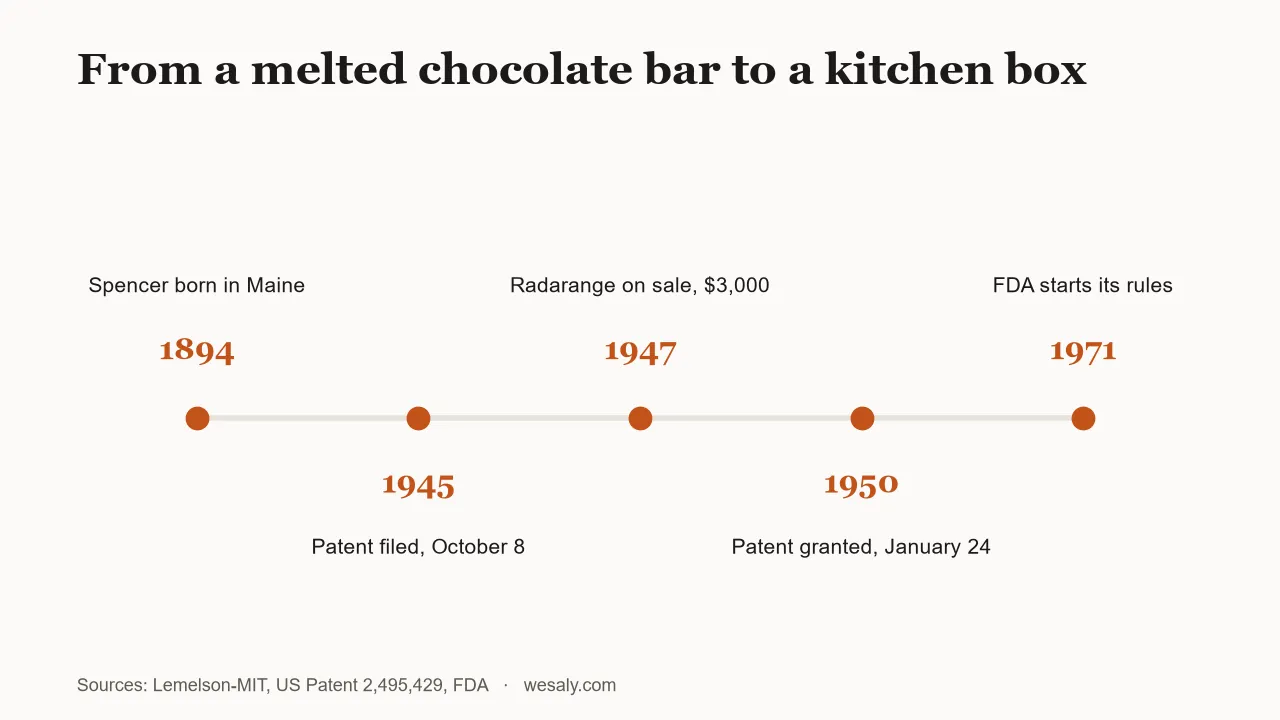
On October 8, 1945, he filed a patent for a "method of treating foodstuffs." Every microwave oven in every kitchen today runs on the idea in that paper.
A self-taught man with a radio tube
Spencer was born on July 9, 1894, in Howland, Maine. He left grammar school at 12 to work in a weaving mill. At 18 he joined the US Navy as a radio operator, and he taught himself calculus and physics from textbooks. By the end of his life he held more than 100 patents.
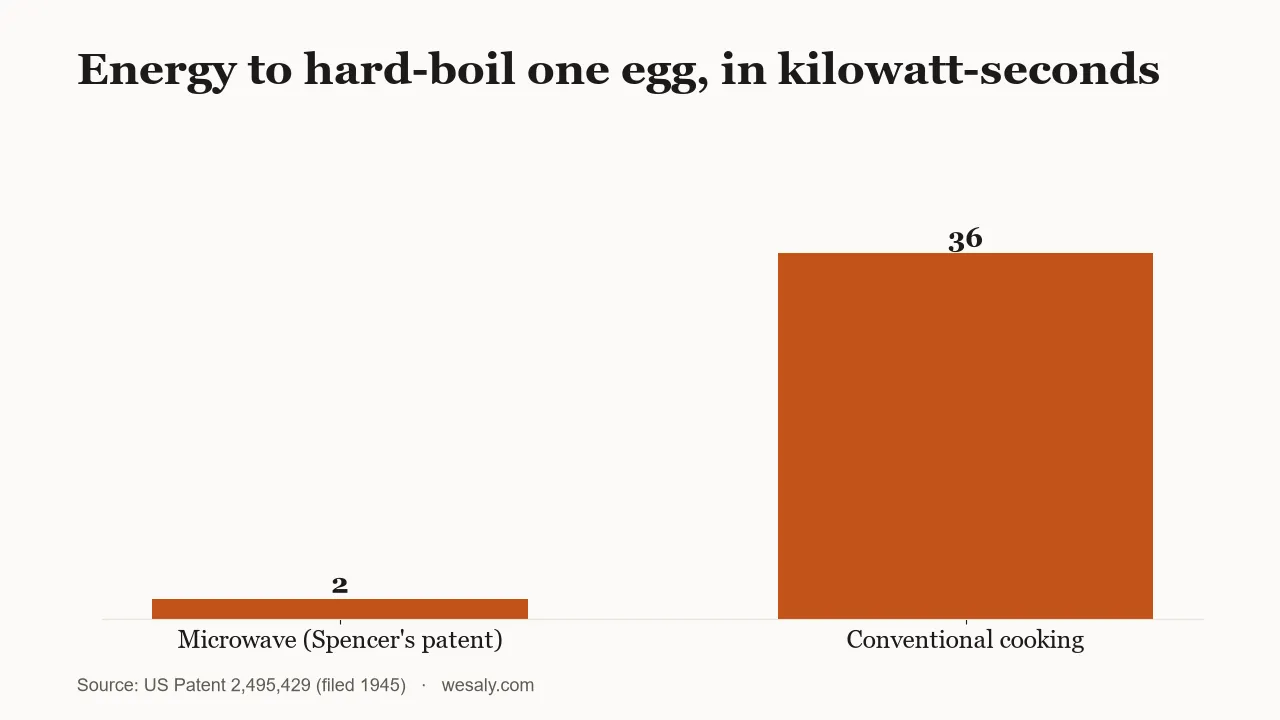
His microwave patent was granted on January 24, 1950. Its numbers still look odd today. Spencer wrote that an egg could be hard-boiled with about 2 kilowatt-seconds of energy, against 36 the usual way. A baked potato took about 240 kilowatt-seconds in his device. An electric oven used about 72,000.
What the waves do to a bowl of soup
Inside the oven, the magnetron makes microwaves. They bounce off the metal walls of the box and pass straight through glass, paper and plastic. Food is different. Food soaks them up.
The US Food and Drug Administration explains it simply. The waves make the water molecules in food vibrate. The molecules rub against each other, and that friction turns into heat. This is also why watery food like fresh vegetables cooks quickly, and why a dry plate can come out cool while the soup on it boils.
The inside-out myth
Many people think a microwave cooks food from the middle outward. It does the opposite.
In thick food, the waves heat the outer layers. The center gets its heat the slow way: it creeps inward from the hot outside, the same way it would in a pan. That is why a frozen lasagna can be bubbling at the edges and still icy in the middle, and why the box tells you to stop, stir and let it stand.
Why the fork sparks
Metal does to microwaves what a mirror does to light. It throws them back. The FDA says metal pans and aluminum foil should stay out of the oven, because the reflected waves make food cook unevenly and can damage the oven itself.
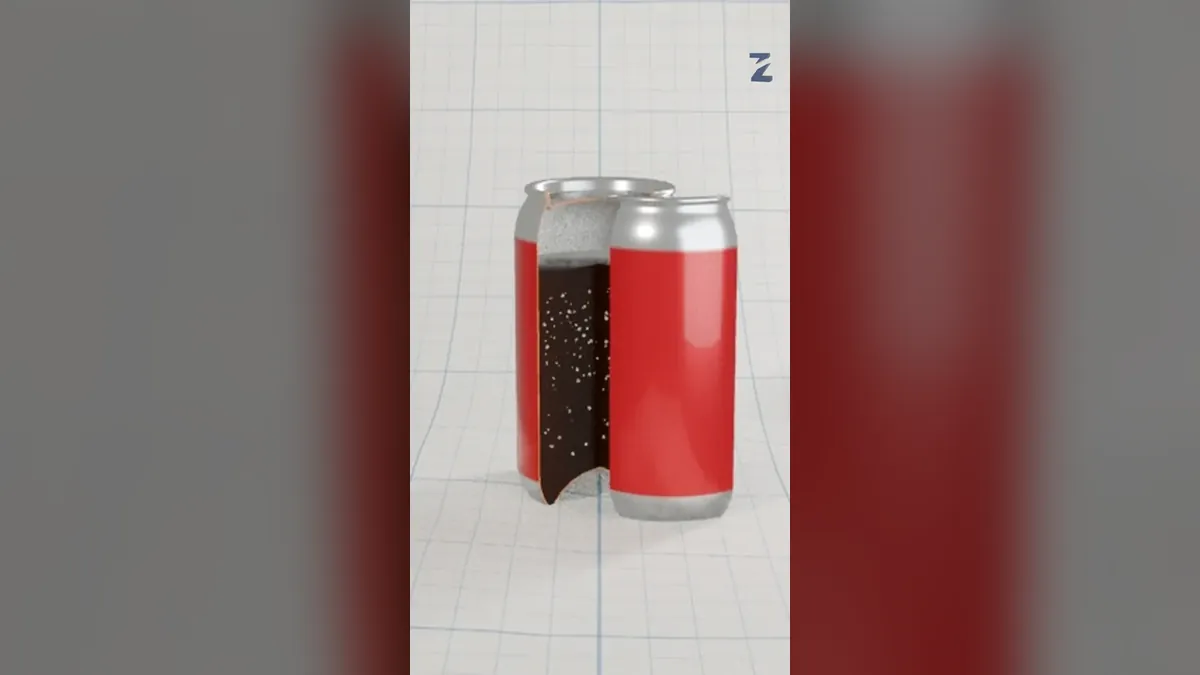
The walls of the oven are metal for the same reason. They keep the waves inside the box, bouncing around until the food absorbs them. Kitchen metal hides other surprises too: a soda can wall is about as thin as paper and still holds its pressure.
Two locks on the door
The FDA has regulated how microwave ovens are made since 1971. A federal rule caps how much microwave energy may leak from an oven over its whole life: 5 milliwatts per square centimeter, measured about 2 inches from the surface. Step back to 20 inches and the reading drops to about a hundredth of that.
Every oven also needs two separate interlocks. Open the door or release the latch, and both cut the microwaves at once.
A fridge-sized first try
The first oven built on Spencer's idea went on sale in 1947. Raytheon called it the Radarange. It stood about 6 feet tall, weighed about 750 pounds and cost $3,000.
It took about 20 more years before a microwave small enough for a home kitchen was ready. Spencer died on September 7, 1970. In 1999 he entered the National Inventors Hall of Fame, a long way from a weaving mill in Maine and a chocolate bar going soft in his pocket.